
How to Improve Your French Listening Skills: Why You Need to Train Your Ears


One of the really important parts of learning a language is listening, although I think it is something that can sometimes get overlooked. We spend so much time learning vocabulary, working through grammar exercises and trying to construct sentences correctly that it is easy to forget that understanding a language when somebody actually speaks it to you is a completely different skill. You can know hundreds, even thousands, of French words and still find yourself completely lost when a French person starts talking at normal speed. You recognise the words when you see them written down, but when they come together in a conversation, somehow they seem to disappear.
If you've ever had that experience, you're certainly not alone, and it doesn't necessarily mean that your French isn't good enough. It often simply means that your ears haven't had enough practice yet.
Listening is something that needs to be trained, just like any other part of learning a language, and one of the things I find particularly useful is to think about listening in two different ways: active listening and passive listening. They have quite different purposes, but both can play an important role in helping you become more comfortable with spoken French.
Active listening
Active listening is when you are really concentrating on what you are hearing and giving your full attention to the French being spoken. You might be listening for a particular grammatical structure, trying to pick out some new vocabulary, or simply trying to understand what the person is saying without constantly translating every sentence into English in your head.
Podcasts can be particularly good for this because you can choose something that interests you and, perhaps more importantly, something that is appropriate for your level. One that I really like is InnerFrench, which I think is particularly useful for intermediate and upper-intermediate learners because Hugo speaks very clearly and doesn't constantly switch into English. If there is a word or an idea that he thinks you might not understand, he will often explain it using other French words or a synonym, which is actually a really useful skill in itself because it encourages you to understand French through French rather than immediately looking for an English equivalent.
The great thing about podcasts is that you can listen to the same thing as many times as you like, and I would actually encourage you to do this rather than feeling that you have to listen to an entire episode from beginning to end. You could take just five minutes of a podcast and listen to that section several times, perhaps making a few notes about what you think you've understood. The first time you might only catch the general idea, the second time you may start recognising particular words and phrases, and by the third time you may be surprised at how much more you can hear.
If there is a transcript available, this is where I think it becomes really useful, but I wouldn't put it on straight away. If you start reading the transcript while you're listening, it is very easy for your attention to move from listening to reading, because reading is obviously much easier when you're learning a language. Your eyes are telling your brain exactly what the words are, so your ears don't have to work quite so hard.
Instead, give your ears a chance first. Listen a couple of times without looking at the transcript and try to work out what you have heard. Then look at the transcript and see how accurate you were. Were there words you completely missed? Were there words you knew perfectly well but simply didn't recognise when they were spoken? Did something sound completely different from the way you imagined it would sound?
This is where the real learning happens, because you're beginning to make that connection between the French you recognise on the page and the French that you hear in real life.

Passive listening
The other type of listening is what I would call passive listening, and this is something I think is particularly valuable because it doesn't require you to sit down and concentrate. Instead, you simply have French playing while you're doing something else.
French radio is brilliant for this. You can have it playing while you're driving, doing the housework, cooking, walking or getting on with all those ordinary things that fill your day. You're not necessarily trying to understand what is being said and you're certainly not expected to remember every word. The French is simply there in the background, giving your brain the opportunity to become familiar with the sound and rhythm of the language.
And I think this is important because French can sound very different when you first start learning it. The words seem to run into one another, people speak quickly, sounds disappear and suddenly the perfectly familiar vocabulary you've been learning doesn't sound anything like the French you've heard in your head.
The more you listen, however, the more your brain begins to recognise those patterns. You start to become familiar with the rhythm of the language and with the way words flow together, and gradually your ears become better at separating all those sounds that initially seemed to be one long stream of French.
You're not necessarily learning individual words during this kind of listening; you're becoming familiar with the language as a whole.
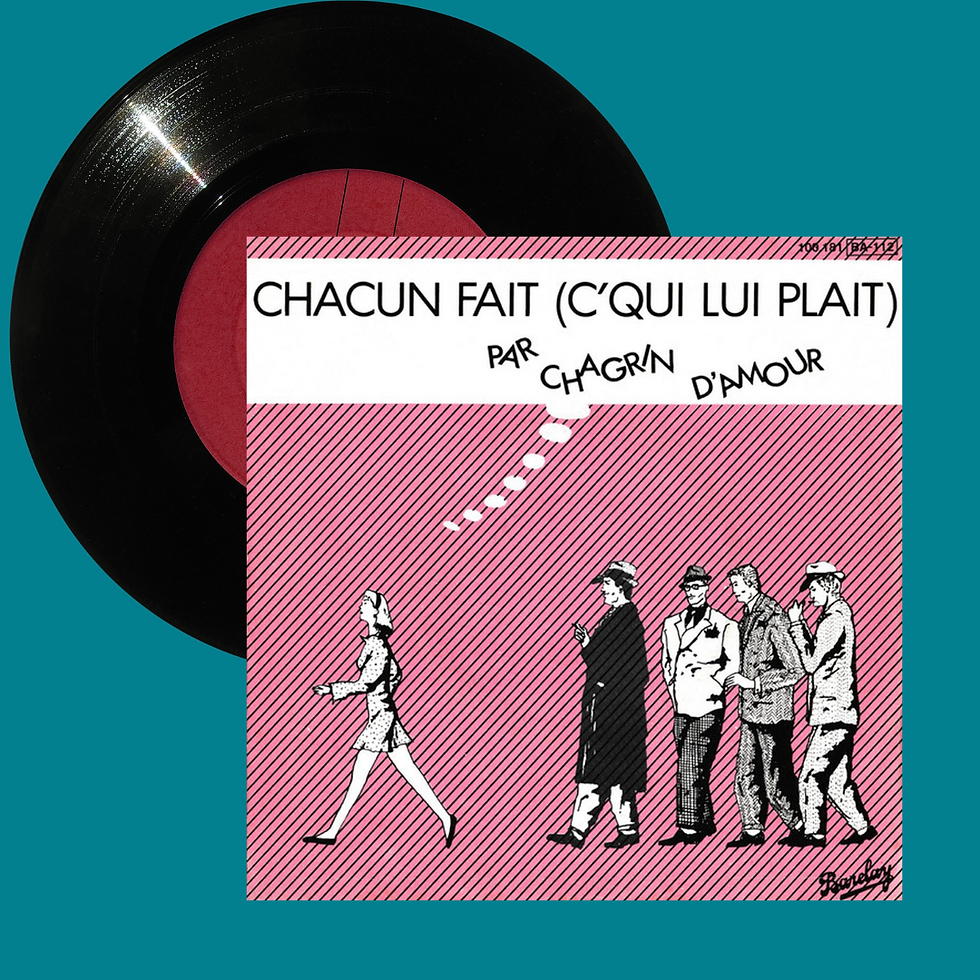
I started listening to French radio when I was twelve
I actually have quite a personal connection with this idea because I started listening to French radio when I was about twelve years old. We were fascinated by France, and my dad used to have French radio playing in the car, so it became something that was simply part of my life. I eventually started having it on in my bedroom as well, instead of Radio 1, which probably tells you quite a lot about how obsessed I was with France at that age!
Of course, I understood very little.
But that didn't really matter.
I would hear the odd word or phrase and occasionally understand something, but most of the time I was simply listening to French. I wasn't sitting there with a notebook trying to learn vocabulary; I was just allowing myself to hear it, and without really realising it, I was becoming accustomed to the sound of the language.
There is one particular memory from that time which has stayed with me all these years.
There was a song that used to come on the radio and I absolutely loved it. It was obviously a big hit in France at the time because I kept hearing it, and although I had absolutely no idea what they were singing about, I didn't care because I just liked the song.
Then, a few years later, when I was in my third year of secondary school, I went on a French exchange. The girl I was staying with had a sister and, at some point during the exchange, she played that very same record, Chagrin d'amour.
I remember thinking, "Oh my God, that radio really exists in these people's lives!"
It sounds strange when I put it like that, but that was genuinely how it felt. I had been hearing this song in England, coming through my radio, without really knowing anything about it, and suddenly I was in France listening to French people listening to the same song. It was a real song that existed in their world, it was part of their culture and it was part of the soundtrack of their lives.
That moment has stayed with me, and even now, whenever I hear that particular record, it takes me straight back there.
Listening isn't always about understanding

I think that experience taught me something quite important about language learning, which is that listening doesn't always have to be about understanding.
We can put a lot of pressure on ourselves when learning a language because we think that if we're listening to French, we should understand everything that is being said. So we put on the radio, hear a conversation we can't follow and quickly decide that it's too difficult or that our French isn't good enough.
But passive listening isn't a test.
If you're driving along with French radio playing and you only understand a few words here and there, that's perfectly fine. You're still giving your brain exposure to French, and you're allowing yourself to become familiar with the sound of the language without the pressure of having to understand every single thing.
You might hear the same expression several times before you realise what it means. You might recognise a voice before you understand what the person is saying. You might suddenly catch a sentence that you would never have understood six months earlier.
Those little moments are all part of the process.
And the other wonderful thing about listening to French radio is that you're getting much more than just language. You're also getting little snippets of French culture. You hear the music people are listening to, the subjects they're talking about, the advertisements, the different accents and voices, the expressions people use and the things that are happening in France at that particular moment.
It's a completely different experience from listening to a recording designed specifically for language learners, because you're hearing French as it actually exists in everyday life.
So how much should you listen to?
There isn't really a magic number of minutes that you need to listen to every day, and I wouldn't want listening to become another task that you feel guilty about not completing.
Instead, try to build it into your life.
Perhaps you could spend ten minutes actively listening to a podcast a few times a week, concentrating on a short section and going back over it several times. Then, alongside that, have French radio playing whenever you're doing something else.
The combination can be really powerful because you're using your ears in two different ways. With active listening, you're concentrating and deliberately trying to understand, while with passive listening, you're allowing yourself to become immersed in the sounds and rhythms of French without putting yourself under any pressure.
And don't worry if you find passive listening frustrating at first. If you put on a French radio station and understand almost nothing, it doesn't mean that you're wasting your time. You may simply not be ready to understand that particular programme yet.
Come back to it in a few months and you may notice that you are suddenly catching much more.
That is one of the most satisfying things about learning a language: realising that something which once sounded completely incomprehensible has gradually started to make sense.
And then there's music...
Of course, we can't talk about listening without talking about music, because music is another fantastic way of getting your ears used to French.
Songs are particularly interesting because you often hear the same song repeatedly, which gives you plenty of opportunity to become familiar with the sounds and eventually start picking out the words. You may find yourself singing along to a song long before you actually understand all the lyrics, and then one day you suddenly realise what you've been singing.
Music also has a way of connecting language with memories in a way that grammar exercises and vocabulary lists simply don't.
I still have that experience with the song I heard when I was twelve. I don't just hear the song; I remember being that age, listening to French radio in my bedroom, being fascinated by France and having no idea that a few years later I would hear that same song playing in the home of someone I was staying with on a French exchange.
That's one of the things I love about learning languages. You're not simply collecting words and grammar rules. You're creating memories and associations that can stay with you for years.
And I think that's a really good reason to make listening part of your French learning, even on the days when you don't feel as though you're understanding very much. I have created a playlist of well know French songs, you can listen to it here
Let your ears learn
So if you're learning French and you feel that your listening isn't keeping up with your reading or vocabulary, don't automatically assume that you need to learn more words.
Perhaps what you need is simply to hear more French.
Give yourself some time each week for active listening, where you concentrate on a short piece of French and really work with what you're hearing. But also find ways to bring French into the rest of your day, whether that's through radio, podcasts, television or music.
You don't have to understand every word, and you don't have to turn every listening session into a lesson.
Sometimes you simply need to let your ears get used to French.
The more you hear it, the more familiar it becomes, and slowly those sounds that once seemed to run together begin to separate themselves. Words become recognisable, expressions start to stand out and conversations that once seemed impossibly fast begin to slow down.
And one day you'll find yourself listening to someone speaking French and realise that you're no longer translating every word in your head.
You're just listening.
And that's when you know your ears are finally catching up with the French you've been learning.


Comments